
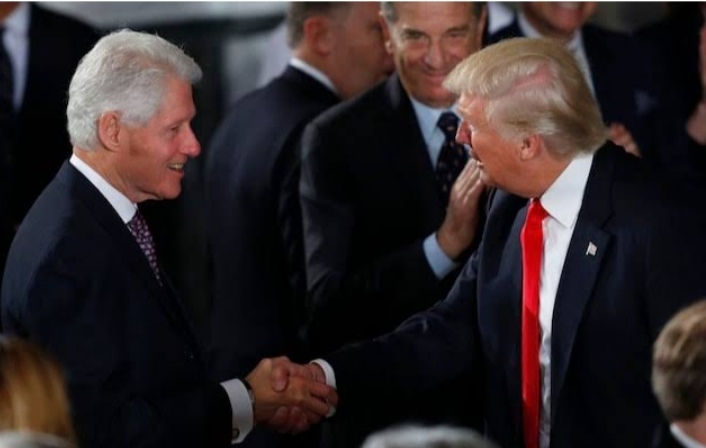
Clinton and Trump
In a candid, if somewhat incendiary, message posted on a popular messaging platform, a Nigerian named Ben Bem Goong took the conversation about gun violence in the United States to a new level, weaving together a recent address by former President Bill Clinton to Nigeria’s National Assembly with the grim statistics of American gun deaths.
“It pains him that many Americans die because of who they are, and not what they have done,” Goong quoted Clinton, adding that a man can “pick up a gun and kill another simply because that other person is black.”

To Goong, this is genocide, and he urges “Trumph”—a thinly veiled reference to former President Donald Trump—to “first end the genocide in America.”
The statement, though peppered with typographical quirks, carries a weight that cannot be dismissed as mere internet rant. It reflects a growing frustration among many observers, both Nigerian and American, that the United States, a nation that often lectures the world on democracy and human rights, struggles to curb a gun violence epidemic that claims roughly 300,000 lives each year, according to CNN’s reporting cited by Goong.
The figure is staggering: three hundred thousand deaths annually translates to more than eight hundred lives lost every single day. If that number were a natural disaster, it would dominate headlines for months; instead, it has become a grim background to everyday American life.
Goong’s juxtaposition of Clinton’s lament with the statistic is a rhetorical device meant to shock. He is not the first to label America’s gun crisis as a form of internal genocide, but his position as a Nigerian observing the United States adds a layer of irony.
For decades, the United States has exported its cultural and political influence across the globe, often positioning itself as a moral arbiter. Yet here is a voice from a country that has its own set of security challenges—ranging from Boko Haram insurgency to banditry in the north—pointing out America’s failure to protect its own citizens.
The reference to “Trumph” is equally telling. Goong seems to suggest that the former president, who during his tenure championed “law and order” and a hard‑line stance on crime, should turn that rhetoric inward and address the domestic bloodshed that plagues his own nation. The misspelling of Trump’s name may be accidental, but it underscores a broader sentiment: the United States’ political leaders are perceived as more concerned with projecting strength abroad than with fixing the rot at home.
Yet, the commentary also raises a question that many Nigerians—especially those who have followed the United States’ political theater—might ask themselves: why should a foreign leader be expected to solve America’s gun problem?
The answer, perhaps, lies in the global interconnectedness of media and the ease with which narratives cross borders. When a Nigerian sees a headline about an American school shooting or a mass shooting at a nightclub, the emotional response is not confined by nationality. It triggers a sense of shared humanity, and sometimes, a sense of disappointment that a nation so rich in resources cannot safeguard its children.
Goong’s final jab—that even highly educated Nigerians believe “Trumph will come and end violence in Nigeria”—is a sharp critique of the lingering post‑colonial mindset that sometimes looks to Western saviors for solutions. It is a reminder that the expectation of external rescue can be both a symptom and a cause of domestic inertia. If Nigerians are waiting for a foreign savior to bring peace to their streets, they may overlook the power of their own institutions to enact change.
The broader implication of Goong’s message is that gun violence is not merely an American problem but a human one, symptomatic of a world where weapons proliferate, where systemic racism can turn a simple altercation into a deadly encounter, and where political leaders often prioritize optics over substantive policy.
The call for “genuine, long‑term reform” echoes a sentiment that resonates far beyond the borders of the United States—whether it is reform of the aviation sector, as another recent commentary suggested, or reform of gun laws, the pattern is the same: fragmented, short‑term measures will not suffice.
In the end, Goong’s commentary serves as a mirror. It reflects America’s own failings, but also the expectations placed on it by the global community. It challenges the notion that the United States can continue to export its values while ignoring the blood on its own streets.
And it reminds Nigerians—and anyone else watching from afar—that the responsibility for change, whether in Lagos or in Los Angeles, ultimately rests with the societies that demand it. The conversation sparked by this single message may yet be the catalyst for a deeper, more honest dialogue about violence, responsibility, and the true meaning of “genocide” in the modern world.
