
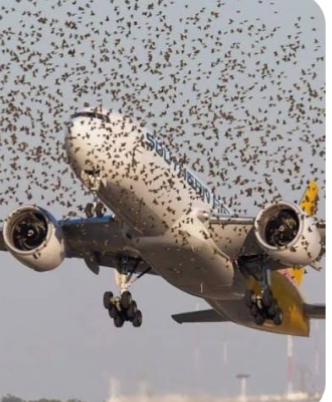
On Valentine’s Day, 2026, United Nigeria Airlines’ Airbus A320 fell victim to yet another bird strike, the latest in a distressing sequence of events that underscore a deeper malaise in Nigeria’s aviation ecosystem.
As the aircraft took off from Asaba International Airport, the whispers of wings met the roar of engines, disrupting what should have been a routine flight.
This incident, like those before it, highlights a systemic issue that transcends airline operations – it speaks to a broader failure in wildlife hazard management.

The numbers are stark. In 2021, Nigeria reported 34 bird strike incidents. By 2022, that figure had ballooned to 93. Over a five-year span, from 2018 to 2023, a staggering 516 wildlife and bird strike incidents were recorded across 20 Nigerian airports, averaging over 100 events annually.
These are not mere statistics; they represent a ticking time bomb of safety risks, operational disruptions, and financial hemorrhaging for airlines.
The burden on carriers like United Nigeria Airlines is multifaceted. Each incident triggers a cascade of costs: engine inspections, aircraft grounding, schedule disruptions, passenger compensation, and brand erosion.
The airline’s operational efficiency is compromised, and its reputation takes a hit. Yet, the responsibility for mitigating these risks lies not with the airlines, but with airport authorities and regulators – the Federal Airports Authority of Nigeria (FAAN), the Nigerian Civil Aviation Authority (NCAA), and the Nigerian Airspace Management Agency (NAMA).
Nigeria’s airports, many situated near wetlands, unmanaged refuse sites, and farming activities, create perfect storm conditions for bird strikes.
The absence of predictive wildlife radar systems, inadequate enforcement of environmental buffers, and reactive rather than proactive management strategies only exacerbate the problem. The lack of investment in modern wildlife hazard management infrastructure is glaring, and the consequences are being felt across the industry.
The solution is neither complex nor insurmountable. It demands deployment of bird detection radar at high-risk airports, strict enforcement of no-dump zones, establishment of professional wildlife hazard management units, and seasonal risk mapping.
It requires treating wildlife hazard management as strategic infrastructure, not an operational inconvenience. The NCAA and FAAN must work together to develop and implement a comprehensive wildlife hazard management plan, incorporating best practices from around the world.
As Nigeria aspires to be a regional aviation hub, it must align its environmental risk management with global standards.
The repeated bird strikes are a glaring reminder of the work left undone. Safety, after all, is layered – and wildlife hazard management is one layer Nigeria cannot afford to neglect.
The time for action is now; the cost of inaction is too high to ignore.
