
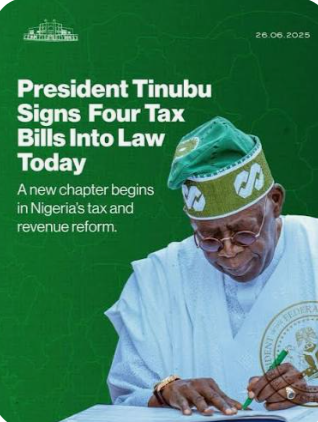
Nigeria’s President Bola Tinubu
By Queen Anieze-Smith | Los Angeles,
California
As a child growing up, I often reflect on what
our Nigeria might look like today had our
ancestors been equipped not only with
resilience and cultural strength, but with
economic knowledge and institutional tools.
Africa is richly blessed with people and
resources, yet history reminds us that while
colonial powers extracted her wealth, they
did not educate the people on taxation, public
finance, or the economic systems that sustain
advanced societies.

That absence of economic education,
particularly around taxes, fiscal governance,
and institutional accountability, has had
lasting consequences on Nigeria.
Without strong and fair tax systems, governments struggle to fund education, healthcare, infrastructure, and social services. Without understanding how economies function, citizens are unintentionally excluded from meaningful participation in nation-building.
Today, however, there is reason for hope.
Across West Africa and the broader ECOWAS
region, I am genuinely delighted to see the
positive direction many leaders are now
moving toward, with renewed focus on
transparency, financial inclusion, currency
stability, and engagement with communities
and the diaspora. Leadership examples such
as those demonstrated under President Bola
Tinubu show that progress is possible when governance is intentional, disciplined, and
people centered.
When foreign exchange systems are better
managed, when banking institutions regain
trust, and when diaspora remittances flow
through formal and accountable channels,
families benefit, businesses plan with
confidence, and communities gain stability.
These outcomes are not only reserved for
advanced nations; they are achieved through
informed leadership and responsible
community participation.
Faith, morality, and economic
responsibility
Faith traditions have long recognized that
economic systems carry moral weight.
In the Bible, Jesus acknowledged the role of
taxes in sustaining society when He taught,
“Render to Caesar the things that are
Caesar’s, and to God the things that are
God’s.” This teaching emphasizes
responsibility, order, and contribution to the
common good—while reminding leaders that
authority must always be exercised with
integrity and restraint.
Scripture further warns us against unjust systems, stating that dishonest scales are condemned while just measures are honored.
Similarly, Islamic teaching places strong
emphasis on justice, stewardship, and balance in economic life. Wealth is viewed as a trust
(amanah), and systems of contribution (Zakat) exist to protect society, support the vulnerable, and prevent exploitation.
Islamic principles also caution against governance that overburdens the people. Hence, leaders should be encouraged to administer taxation with wisdom and mercy, helping citizens understand that their contributions are not merely obligations, but investments in their collective future.
Across Christianity, Islam, and shared moral
traditions, the message is the same: economic systems should help people, leaders must
manage resources wisely, and citizens should
contribute in ways that build the community
without harming individual wellbeing.
A Call to Action
This is a defining moment. Governments
must continue investing in tax education,
transparent institutions, and inclusive
financial systems, while faith leaders and
civic institutions help nurture ethical
leadership and shared responsibility. This
work is deeply personal and grounded in
lived experience rather than theory alone.
Before my time in the village, my family
was forced to relocate from Lagos during
the civil war, a displacement that resulted in
separation from the primary breadwinners in
my family, my mother and my grandfather.
In the village in Nigeria’s Delta region, I
assisted in small-scale trading simply to
survive. These early experiences highlighted
the profound vulnerability of families when
conflict disrupts livelihoods and economic
systems are weak or absent. They also
reinforced the critical role that sound fiscal
policy, effective taxation, and functional
institutions play in restoring stability,
protecting households, and supporting long term economic development.
Over time, that lived experience evolved
into formal study and professional practice
in accounting and taxation. It shaped my
understanding that sound fiscal policy,
effective tax administration, and inclusive
financial systems are not merely technical
tools, but essential pillars of economic
resilience and intergenerational prosperity.
This perspective underpins my continued
advocacy for structured diaspora
engagement, through formal investment,
knowledge transfer, and institutional
collaboration, so that today’s contributions
translate into sustainable opportunity for future generations.
Publication disclaimer: This opinion article reflects the personal views of the author and is intended for civic, educational, and interfaith dialogue. It does not constitute official government policy or endorsement.
About the Author:
Queen Anieze-Smith is an Economist, Business consultant, and Taxation professional with over 25 years of experience in economic analysis, business advisory, and tax policy implementation. Her work focuses on financial education, institutional strengthening, and bridging best practices from advanced economies to emerging and developing market
