
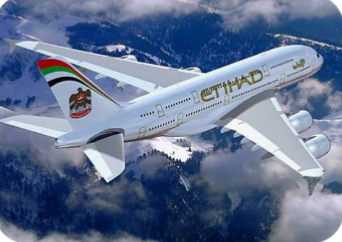
Nigeria’s skies are about to get busier, and more global, with the announcement that Etihad Airways is set to return to the country after years away. The news came on Thursday when a high-powered delegation from the Abu Dhabi-based carrier walked into the office of the Honourable Minister of Aviation and Aerospace Development, Festus Keyamo, SAN, in Abuja, not with promises, but with dates.
Led by Capt. Khalid Humaid Al Ali, Senior Vice President for Aeropolitical, International and Government Affairs, the Etihad team came with a clear message. They are ready to fly to Nigeria again. The plan, Capt. Al Ali told the Minister, is to begin daily services to Lagos between March 24 and 27, 2027, using Etihad’s flagship Boeing 787 Dreamliner. The aircraft, known for its quiet cabin, fuel efficiency and passenger comfort, will be the face of the airline’s return to West Africa’s largest market.
But the delegation did not come empty-handed on partnerships either. Capt. Al Ali disclosed that Etihad has already concluded a landmark codeshare agreement with Air Peace, Nigeria’s most prominent indigenous carrier. It is a move that instantly connects Etihad’s global network to Air Peace’s domestic and regional routes, and gives Nigerian travelers smoother access to the Middle East, Europe, Asia and beyond. The Minister was quick to applaud it. “I saw you just signed a very good deal with Air Peace yesterday. That’s very good. Air Peace is one of our trusted and most reliable airlines. We are supporting them to grow. It is a very proud Nigerian flag carrier,” Keyamo said, his tone warm and deliberate.
The meeting was more than ceremonial. Seated around the table were the key custodians of Nigeria’s aviation infrastructure. The Director General of the NCAA, Capt. Chris Najomo. The Managing Director of FAAN, Mrs. Olubunmi Kuku. The Managing Director of NAMA, Engr. Umar Farouk. With them, the conversation quickly turned from announcement to execution. And it was here that the Minister made his most passionate pitch.
Lagos, he acknowledged, is the obvious first choice. But Lagos is also saturated. Terminals are under renovation, gates are tight, and thousands of passengers from the North still have to make the long road or air trip down south just to connect internationally. “Lagos is saturated, but we want to make all the space and everything available for you in Abuja,” the Minister said. “So many passengers from Northern Nigeria travelling to the UAE or transiting to Saudi Arabia for Umrah and other destinations currently have to travel all the way to Lagos to board flights. Everyone has been asking for Abuja. If you start Abuja, you will be amazed by the passenger traffic. So, we are begging you to include Abuja.”
It was an appeal rooted in geography and faith as much as economics. Abuja sits at the center of the country. From there, pilgrims heading for Umrah, business travelers bound for Dubai, students and families connecting onward could board without the burden of a domestic connection first. FAAN’s boss, Mrs. Bunmi Kuku, responded in kind, assuring the Etihad team that even amid ongoing upgrades at Murtala Muhammed International Airport, the Authority would create operational space for them at the temporary terminal in Lagos. “Space will be tight,” she admitted, “but every effort will be made to accommodate the airline.”
To make sure nothing slows the process, the Minister directed the immediate set-up of a joint working committee comprising officials of the Ministry, its agencies and Etihad Airways. The first virtual meeting is expected as early as next week, to fast-track approvals, slots, ground handling and all the operational planning that turns an announcement into an aircraft on the tarmac.
For Nigeria, the return of Etihad is more than another foreign airline on the schedule board. It is a signal. Under President Bola Ahmed Tinubu’s administration, the aviation sector has been pushing to reposition Nigeria as a destination that global carriers and investors can trust again. Bilateral talks, infrastructure upgrades, and a deliberate push to support local carriers like Air Peace are all part of that agenda. Etihad’s decision, coming with a codeshare and a wide-body aircraft on day one, reinforces that growing confidence.
For passengers, it means choice. It means competition on fares. It means a Dreamliner from Lagos to Abu Dhabi, and from there to more than 80 destinations worldwide, without the multiple stops and long layovers that have defined travel for many Nigerians in recent years. And if the Minister’s push for Abuja succeeds, it could mean that a traveler in Kano, Kaduna or Jos will soon have a shorter journey to their international flight.
Capt. Al Ali said the push to return had also been encouraged by Nigeria’s Ambassador to the UAE, a sign of the diplomatic weight behind the route. Etihad, for its part, is betting on Nigeria’s population, its diaspora, and its position as a gateway to West and Central Africa.
As the delegation left the Ministry, the tone was optimistic but practical. The dates are set for March 2027. The aircraft type is decided. The partnership with Air Peace is signed. Now comes the work of committees, approvals, and infrastructure.
In aviation, announcements are easy. Landings are harder. But with a Minister who is openly lobbying for more Nigerian cities to be served, a regulator ready to facilitate, an airport authority promising space, and an airline arriving with a Dreamliner and a partner in Air Peace, the pieces are aligning.
Welcome back, Etihad Airways. Nigeria has been waiting.
