
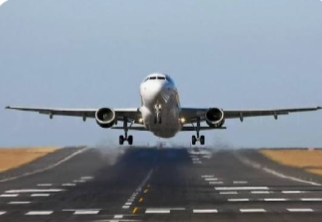
When a flight departs Lagos for Abuja, or climbs out of Kano toward Accra, passengers rarely think about what keeps that aircraft safe between take-off and landing. They trust that someone, somewhere, is watching the radar, calibrating the instruments, and keeping the signals alive. That someone is the Nigerian Airspace Management Agency, NAMA.
As the National Assembly opens public hearing on the Ticket Sales Charge, TSC, on Thursday, 6th August in Abuja, the conversation is no longer about percentages on paper. It is about who bears the weight of keeping Nigeria’s skies safe, and whether the money meant for that purpose matches the responsibility.
The National Association of Air Traffic Engineers, NAAE, has asked lawmakers to take a fresh, objective look at the current 5% TSC sharing formula.
In a statement signed by NAAE’s President Engr. Selzing Miri and Secretary Engr. Mohammed Shuaibu, the engineers warned that Nigeria cannot meet its obligations as an Air Navigation Service Provider if the agency tasked with that duty continues to operate under financial strain that no longer reflects reality.
The numbers tell part of the story. Today, NAMA receives 23% of the TSC while the Nigerian Civil Aviation Authority, NCAA, receives 57%. NAAE says that formula was set decades ago, when aviation technology was far simpler. Since then, the industry has changed completely. Nigeria has moved into Performance-Based Navigation, satellite surveillance, digital communications, ADS-B, Multilateration, and cybersecurity systems that are all ICAO-mandated.
Yet NAMA’s share of the charge has remained largely static, even as the cost of procuring, installing, calibrating and maintaining these systems has grown exponentially.
This is not, NAAE insists, a fight between agencies. It is a national question. Regulation is vital, and NCAA’s oversight role deserves proper funding.
But regulation alone does not guide an aircraft through weather, or talk a pilot down through low visibility, or keep radar screens lit at 3am. Safe flight operations happen only when strong regulation is matched by reliable, uninterrupted air navigation services.
And that is where NAMA lives — in the 24 hours, 7 days reality of CNS/ATM. Every take-off, every en-route transit, every instrument approach and every landing in Nigerian airspace depends on systems designed, installed and maintained by NAMA’s Air Traffic Safety Electronics Personnel.
Radar, ILS, DVOR/DME, satellite navigation infrastructure, communication networks, aeronautical information management, flight calibration programmes, power systems and cybersecurity architecture are not optional extras. They are the backbone. They are safety-critical, capital-intensive, and they cannot be switched off.
Unlike most aviation services, these facilities do not close. They run continuously, maintained by highly skilled engineers whose work is invisible to passengers but indispensable to safety. When funding lags, the risk is not inefficiency. The risk is deterioration. And deteriorating navigation infrastructure exposes the nation to operational and safety risks no country can afford.
NAAE’s appeal ahead of the public hearing is simple and patriotic: let the review be guided by statutory mandates, operational realities, funding needs and evolving responsibilities. Let the allocation reflect who does what, and what it costs to do it well in 2026. The goal, they say, should not be institutional rivalry but national interest — building a stronger, safer and more resilient aviation system that can support Nigeria’s ambition to be Africa’s leading aviation hub.
As lawmakers sit in Abuja on Thursday, the question before them is clear. We can celebrate more flights, more routes, and more passengers. But none of that matters if the systems that keep those flights safe are underfunded.
The sky does not negotiate. Safety is not a line item. It is an investment. And for Nigeria to keep flying safely, the agency that keeps the airspace alive must be funded to match the responsibility it carries.
