
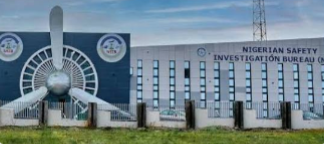
The Nigerian Safety Investigation Bureau has put the facts on the table three weeks after Enugu Air’s Embraer ERJ 170-100LR, registration 5N-ENR, ran off Runway 05 at Oba Akenzua II Airport in Benin on July 23, 2026, and it is clear that while all 68 people on board walked away unhurt, the circumstances point to deeper issues around airport infrastructure and information flow that regulators can no longer ignore.
According to the preliminary report released Thursday in Abuja, the aircraft carrying 63 passengers and 5 crew landed normally but overran into the unpaved area beyond the runway, striking approach lights and two concrete structures tied to a decommissioned localizer, an outcome that could have been far worse if not for the emergency evacuation that followed.
NSIB’s early findings, drawn from flight recorders, ATC communications, witness accounts and an initial airframe inspection, do not yet apportion blame, in line with ICAO Annex 13, but they do raise immediate red flags through four safety recommendations to NCAA, FAAN and NiMET.
The focus is telling: the runway-end environment at Benin, the control tower’s line of sight, and the availability of timely meteorological information.
That suggests investigators are already looking at whether the physical space beyond the runway was adequate, whether controllers could see what was unfolding, and whether pilots had all the weather data they needed in real time.
The Bureau’s decision to also release a preliminary flight path recreation video underscores its push for transparency, letting the public and aviation community see what the data shows so far while reminding everyone that this is not the final word.
For Nigeria’s aviation sector, the takeaway is twofold. First, the fact that there were no injuries validates crew training and emergency procedures.
Second, the recommendations signal that preventing the next overrun will require more than good airmanship.
It will require FAAN to address runway safety areas and obsolete structures, NCAA to enforce visibility and operational standards, and NiMET to ensure weather information gets to the cockpit when it matters most.
With the investigation still ongoing and a final report pending, the pressure is now on the three agencies named to act on the interim advice before the full conclusions are drawn.
