
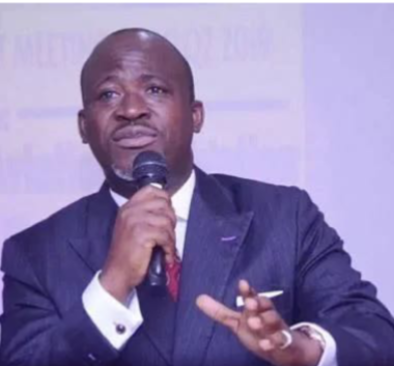
Akin Olateru
The ambient hum inside Murtala Muhammed Airport Terminal 2 in Lagos carried something different that afternoon. It was not the usual rush of boarding calls and rolling luggage. It was the sound of history being nailed to a wall.
On that day, Bi-Courtney Aviation Services Limited and the Nigeria Aviation Hall of Fame unveiled a permanent wall of honour at MMA2. Eighteen names were etched into it, men and women whose decades of service had quietly built the Nigeria we fly in today. Among them, one name drew a long, steady gaze: Engr. Akinola Olateru.
For Olateru, Chairman and Chief Executive Officer of OmniBlu Aviation, the induction was more than a plaque and photographs. It was permanence. A career that began on tarmacs and in hangars, with grease under the nails and licenses in three countries, was now anchored into the very terminal where thousands of Nigerians begin their journeys.
But Lagos was only half the story. On the same week, 700 kilometers away in Abuja, at the National Tourism Transport Summit and Expo, Olateru was also being robed into the Body of Fellows of the Institute for Tourism Professionals of Nigeria. ITPN reserves that fellowship for those who have fought, not just worked, for the professionalisation of tourism and transport. Two cities. Two institutions. One man.
That dual recognition said something bigger than personal achievement. It said that safety and service, engineering and hospitality, are not separate lanes. They are the same road. Without safe skies, there is no confident traveler. Without confident travelers, there is no tourism, no trade, no growth.
Olateru’s road to that point spans nearly four decades. He started where aircraft are fixed, not where they are announced. He earned licensed aircraft maintenance engineer status in Nigeria, the UK, and the USA, a rare trifecta that meant he could read an aircraft in any language it spoke. But he knew that turning wrenches alone would not transform a system. So he went back to school. An http://M.Sc in Air Transport Management from City University London. Executive programs at the London School of Economics. The Certificate of Management Excellence from Harvard Business School.
It was that blend, hands in the engine and eyes on policy, that prepared him for his most public assignment. As Director-General of the Nigerian Safety Investigation Bureau, formerly AIB, he inherited an agency with backlogs and questions. Over six years he changed the tempo. Reports were released faster and clearer. Laboratories for flight data recovery were upgraded. Partnerships were built with global regulators. Most importantly, the culture shifted from reacting after accidents to preventing them before they happened. For domestic airlines and foreign carriers flying into Lagos and Abuja, that shift meant confidence.
The world noticed. He was admitted as a Fellow of the Royal Aeronautical Society in the UK, a Fellow of the Chartered Institute of Logistics and Transport, a Fellow of the Nigerian Society of Engineers, and a member of Chatham House. Aviation media called his reforms a benchmark for emerging markets.
In 2013, while still serving, he planted another seed. OmniBlu Aviation Limited was built on a simple idea: business aviation should meet the same non-negotiable safety standard as national infrastructure. “Beyond first class” was not a slogan. It was a promise that premium charter and specialized air services could be as disciplined as a state regulator. Under his watch, OmniBlu has become a reference point for compliance and efficiency.
Now his name sits on the NAHOF wall at MMA2, beside pioneers who came before him. The wall was designed to do more than remember. It was designed to teach. Every passenger who walks past will see that Nigeria’s aerospace story was built by people, not just policies.
The ITPN fellowship in Abuja added another layer. It tied aviation to tourism, to transport, to the economy that moves when people feel safe enough to move.
Dual honours in one week could have felt like a culmination. But those who know Olateru say it feels more like a marker. His work has always been about bridges, between engineering and management, between public service and enterprise, between Nigeria and the global aviation community.
As the lights dimmed in Terminal 2 and the wall caught the last of the afternoon sun, the message was clear. Legacy is not just what you leave behind. It is what you keep building while you are still here.
And on that wall, in that fellowship, Engr. Akinola Olateru’s name now does both.
