

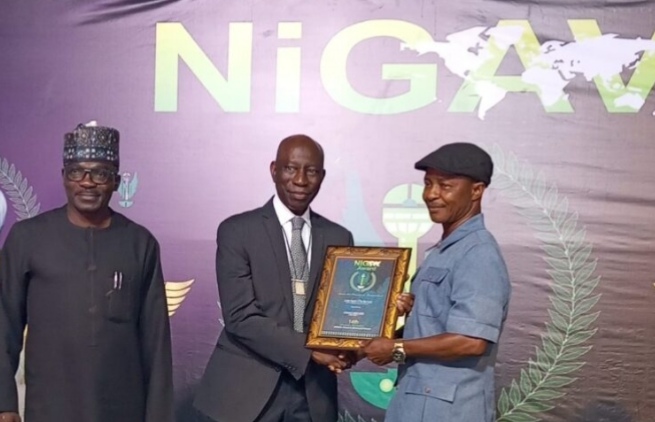
Former MD, FAAN, Aisuebeogun presenting award of excellence to NCAA DG, Capt Najomo
It was a night of good music, food and fun at the NIGAV award night for excellence which held in Lagos, weekend,
At the gathering of the creme de la creme of the Nigerian aviation sector, reward were given to industry players who have distinguished themselves through honesty, dedication and hard work in diverse fields.
The occasion was also used by industry pundits to reflect on the sector with the aim to finding ways to dissect the past to understand the present and then project into the future.

And it was in doing this that Dr. Richard Aisuebeogun, Co-Chairman of the NIGAV Award Committee, divulge that the Nigerian aviation industry has witnessed significant developments in 2024, with a mix of achievements and challenges.
According to him, the industry has to a considerable measure shown resilience despite the economic volatility and high cost of air transportation.
According to him, the last year scored some positive points for the sector through government’s efforts to resolve the $800 million debt issue with foreign airlines, which he said have gone a long way to restore international confidence in Nigeria’s aviation industry.
This move, he said, has paved the way for Nigerian airlines to expand their operations globally, including Air Peace’s historic entry into the UK market.
Aisuebeogun also touched on the growth recorded by Nigerian Airlines which have continued to modernize their fleets, with notable acquisitions by Air Peace, Ibom Air, and Overland Airways.
The Cape Town Convention (CTC) agreement was also said to have opened up opportunities for dry leasing, enabling airlines to access international financiers.
And despite obvious challenges, the industry has also seen progress in infrastructure development, including the installation of airfield lighting systems and radar equipment at various airports.
The upgrade of air traffic management systems to satellite-based navigation is also mentioned as a significant step forward.
However, high operating costs have donstituted an obstacle. The industry has faced challenges due to the high cost of Jet-A1 fuel, low passenger traffic, and non-availability of foreign exchange for maintenance.
Service quality by providers to passengers was also observed to have been below quality, including flight delays and unacceptable incidents of rights abuse.
The result of these shortcomings snowballed into some safety hitches leading to some non-fatal incidents, including a helicopter crash involving East Wind Aviation.
So, for the year 2025, industry pundits are proposing that government should commence airport concessions and concentrate more on, inviting private sector investment in airport infrastructure.
Improved immigration processing was also highlighted as part of the ways forward. Collaborative efforts between the Ministry of Aviation and the Ministry of Interior Affairs are expected to lead to more efficient immigration processing.
The cargo sector of the industry however received a pass mark as it was observed that cargo operations are experiencing a rise in cargo inflow, driven by improvements in international e-commerce gateways.
Aisuebeogun recommended that the government must harmonize the raised agenda with the previous aviation roadmap to ensure consistency in policy implementation.
Government is also urged to provide support to the industry, including tax incentives, waivers, and consistent policy to improve air transportation infrastructure.
The industry on its own needs to explore various funding options, including finding a way around establishing a sector bank to ensure financial stability.
As the industry looks to 2025, it is clear that there are opportunities for growth and development. With the right support and policies in place, Nigeria’s aviation industry can overcome its challenges and thrive.
