
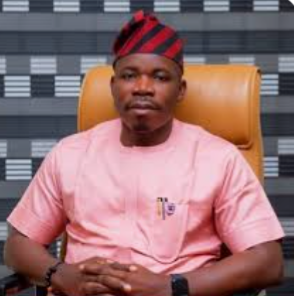
Osanipin
Inside Oluwemimo Osanipin’s quiet revolution at the National Automotive Design and Development Council
By Gboyega Adeoye
Special feature (The Kiriji Times)
There is a kind of public officer you do not meet at loud press briefings. You find him in plant floors, in spreadsheets, in the footnotes of a policy document that most people will never read. That is Oluwemimo Joseph Osanipin.
Appointed Director-General of the National Automotive Design and Development Council in October 2023 by President Bola Ahmed Tinubu, Osanipin was handed one of the most exacting briefs in government: make Nigeria build, buy, and believe in its own vehicles again. It is the sort of assignment that exposes pretenders and rewards only those who are sound in knowledge, painstaking at duty, and diligent at work. In Osanipin, the assignment found its match.
He comes from Okeako, a quiet town in the northern belt of Ekiti State, where diligence is a family inheritance and noise is not a substitute for results. The story they tell there is simple: a boy who loved numbers more than noise, who asked more questions than he answered, and who grew into a man who balances ledgers with the same seriousness he brings to national policy.
That training shows. A first degree in Management and Accounting from Obafemi Awolowo University, an MBA from the University of Benin, a Fellowship of the Institute of Chartered Accountants of Nigeria, and a certification as an Information Systems Auditor.
Before public service, he earned his stripes where there is no room for error, at Zenith Bank and the GIG Group. Banking taught him risk. Logistics taught him speed. NADDC is where he is using both.
At the Council, the talk is no longer of ambition alone, but of assembly lines, financing models, and market access. President Tinubu’s ‘Nigeria First’ policy, under Osanipin, has moved from slogan to schedule. The idea is straightforward and stubbornly patriotic: patronage must meet production. If a Nigerian family can buy a vehicle assembled in Nnewi, Lagos, or Kaduna at a monthly repayment that competes with a fairly-used import, then the choice becomes practical as well as national.
To get there, he has gone to the Bank of Industry to structure collaborations that make locally assembled brands like Innoson, Nord, and Jet more affordable. He sits with engineers in the morning and financiers in the afternoon, because he understands that a car is both metal and money.
He is also looking past the petrol engine. As the public face of NADDC’s Electric Vehicle push, he is laying the groundwork most people do not see: standards that will keep Nigerian roads safe, a framework for recycling automotive waste so the transition does not create a new problem, and conversations with investors who must be convinced to localize assembly rather than ship kits. It is unglamorous work. It is also the work that decides whether Nigeria will own the next phase of mobility or only watch it from the roadside.
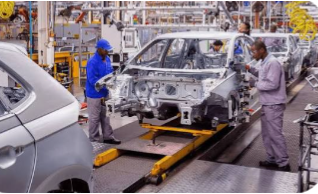
What sets him apart is method. In an agency that could easily be ceremonial, he has made it operational. He reads the data. He audits the process. His background as a systems auditor shows in how he insists on controls that cannot be gamed and metrics that cannot be hidden.
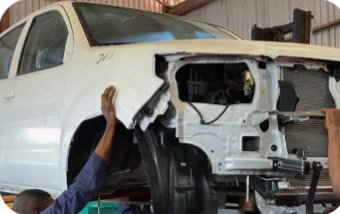
Colleagues say he is the DG who will ask for the invoice, the inspection report, and the customer repayment schedule in the same meeting. That is the genius part, the discipline of turning white papers into welds, incentives into inventory, and intent into ignition.
The stakes are larger than cars. An automobile industry is a base industry. When a plant runs three shifts, steel mills, glass makers, electronics vendors, upholstery workshops, and a chain of small suppliers breathe easier. Every Nigerian-assembled vehicle is a welder employed, an electrician trained, a parts trader paid, and a skill that stays in the country.
That is what ‘Nigeria First’ means in Osanipin’s hands: technology transfer that does not exit at the next port, and investments that put roots down in Nigerian soil.
He does not court controversy, and he does not chase virality. He is from a place that prizes quiet work, and he has brought that ethic to Abuja. The boy from Okeako who preferred ledgers to leisure is now accounting for an industry. If the numbers, the plants, and the policies align, the next decade of Nigerian mobility may be written in a language he helped design: Made-in-Nigeria.
Under President Tinubu’s government, the bet on local capacity is clear. At the valve of that bet is a chartered accountant from Ekiti who treats public service like an audit with consequences. He is not loud. He is effective.
And in this season, effectiveness is the rarest currency of all.
