
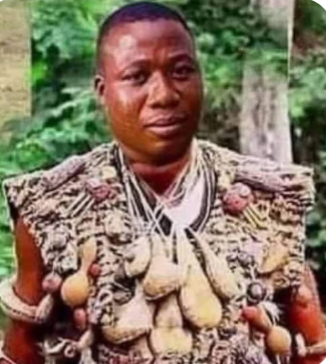
Chief Sunday Adebayo
By Gboyega Adeoye
His name is Sunday Adeyemo, but the street calls him Igboho, after the soil that made him. He did not walk into Nigeria’s consciousness through a press conference. He rode in on the smoke of the Ife–Modakeke crisis, a young man who discovered early that history remembers those who run toward fire, not from it.

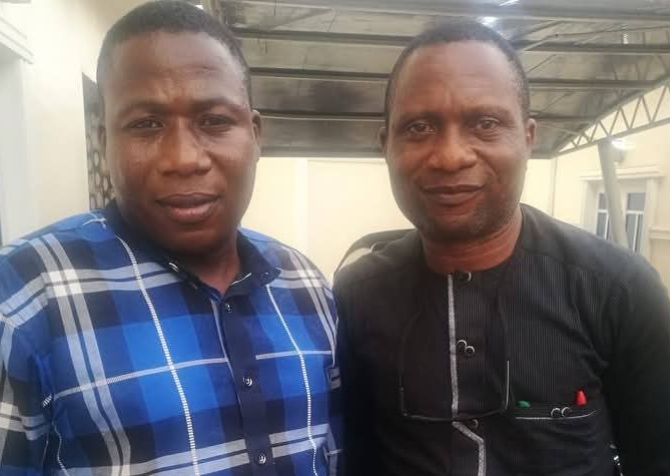
Igboho with Gboyega Adeoye
Since then, one thread has stitched every chapter of his life: a dogged, unnegotiated love for the Yoruba people. Not the performative kind that trends with hashtags. The kind that stands between herdsmen and farmers at 2 a.m. The kind that empties its own pocket before it passes a hat around. In an era where “freedom fighter” has become a costume too many wear to auditions for power, Igboho wears no costume. He wears shirts. Casual ones. And he leads from the front.
Ask around his Ibadan compound and you’ll hear the same refrain from men who have followed him into danger: He never sits at the back and feeds on his followers. When battle calls, he is the first boots out. When glory, fame, and the allure of life beckon, he takes the back seat. That is not rehearsed humility. It is reflex.
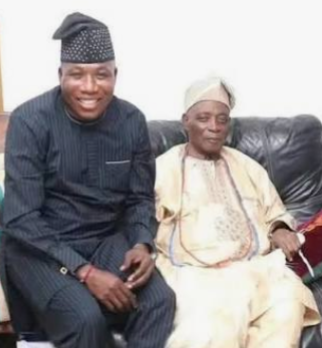
Igboho with the Olubadan, Oba Ladoja
The Yoruba have seen the other kind. The liberators who liberate themselves first. The activists who arrive at the struggle out of jealousy for those in power, not love for those under it. You know them by the aftermath. When they think they’ve reached their zenith, the mask slips. They bare their fangs, ride roughshod over comrades, and breathe contempt on the very hands that lifted them.
Sunday Igboho is of a rarer grain.
My maiden encounter with him came at the peak of his agitation for a Yoruba nation. A pro-liberation movement of Yoruba sons and daughters across the globe delegated me to meet him in Ibadan, days before a declaration he had already scheduled. I arrived at his residence to a welcome that disarmed. He took one look, read the road on my face, and suspended the meeting. “You’ve come far,” he said. “Rest first. We talk tomorrow.” He then instructed one of his men to lodge me in a hotel, stay with me, and run every errand I needed.
The journalist in me went to work. I asked questions. I listened. What I found was not a warlord but a warden of his people. He goes to every liberation battle with his team. He cares for them, and for their families. His compound feeds everyone in it. He keeps a leveler’s relationship with his men — no one is imprisoned in deed or in thought. Rank does not swell his head, and loyalty does not shrink his heart.
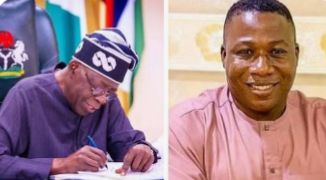
That loyalty runs upward too. He speaks with unflinching respect of the Olubadan, Oba Rashidi Ladoja, and by extension, of the President of the Federal Republic, Bola Ahmed Tinubu. It is a strange thing in this climate: a street general who understands protocol, a fighter who understands order. But it is consistent with the man. Diligence to a belief, he seems to say, will eventually make you dine with kings and presidents.
Igboho is not in this for trade. He is in it for emancipation — to break the shackles of those paralysing the economy of his people to fester their own trade, and those who find comfort in inflicting pain as a means of survival. He is not building a brand. He is defending a bloodline.
Simplicity defines him. No entourage of praise singers. No convoy of luxury for cameras. His casual lifestyle is not strategy; it is substance. In a room of agitators, he is the one asking if everyone has eaten.
Every generation produces men who shout. Few produce men who shield. Sunday Igboho shielded. He still does.
And perhaps that is why, when you say his name in markets from Iseyin to Ilesa, mothers don’t lower their voices. They lift their heads. Because they know: if danger comes, one man will not tweet about it from a safe distance.
He will run toward the fire.
As Yoruba sages say, “Eni t’ó bá mọ iyì ẹ̀dá, kì í ṣe ohun gbogbo l’ó ń jẹ” — he who knows the worth of life does not eat everything placed before him. Igboho has been offered many plates. He chose his people.
That choice, in this age, is the rarest promotion of all.
