
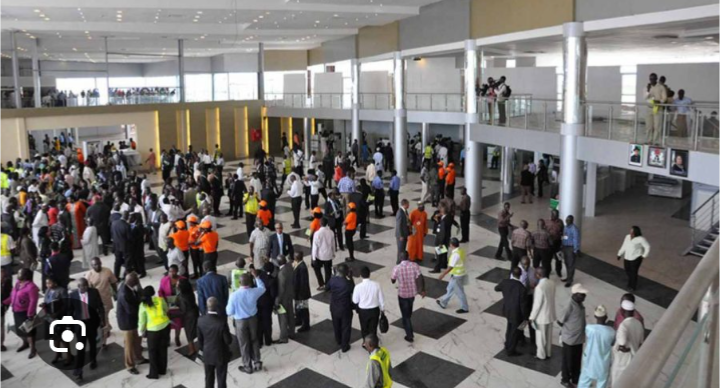
Stranded passengers at MMA2
It was still dark on Tuesday morning when the first passengers arrived at Murtala Muhammed Airport in Lagos and Nnamdi Azikiwe International Airport in Abuja, dragging luggage and expectation, only to meet locked counters, grounded aircraft, and union officials standing firm at the gates. The National Union of Air Transport Employees, NUATE, the Air Transport Services Senior Staff Association of Nigeria, ATSSSAN, and the National Association of Aircraft Pilots and Engineers, NAAPE, backed by the Nigeria Labour Congress and the Trade Union Congress, had shut down Air Peace operations over what they described as two festering wounds in Nigeria’s aviation sector: the right of workers to unionize freely, and the non-remittance of the 5% Ticket Sales Charge that funds the very agencies meant to keep the industry alive.
For the unions, this was not an ambush. They pointed to a notice first issued on August 4, 2026, warning that they were “ready to strike at any time without further notice.” After weeks without what they called meaningful engagement, they said restraint had run out. Their grievance goes beyond one airline. They allege that some domestic carriers have created an atmosphere where staff are too afraid to even express interest in union membership, for fear of victimization or subtle discrimination, despite repeated efforts by aviation unions to secure that constitutional right. To them, a workforce that cannot organize is a workforce that cannot negotiate decent conditions, and that silence comes with safety implications.
The second grievance cuts to the heart of how aviation is funded in Nigeria. The 5% Ticket Sales Charge collected on every ticket is not airline money. It is statutory revenue meant for the operational running of aviation agencies like the NCAA, NAMA, and others. The unions and the labour centers argue that when airlines withhold it, they are not just starving regulators, they are also stalling collective bargaining agreements already negotiated for agency staff. “This continues to breed disgruntled air transport workers,” their statement read, “the implication of which is an accident in the waiting.” In their view, funding and safety are not separate conversations. An underfunded regulator, an underpaid technical staff, and a demoralized workforce are links in the same chain.
Air Peace, the airline directly picketed on Tuesday, had not issued a public statement at press time, leaving passengers to bear the immediate brunt: missed meetings, disrupted travel plans, and hours spent in terminals with little clarity. The Airline Operators of Nigeria, AON, have been locked in the same dispute with labour over the TSC remittances, and at the weekend the unions had issued a fresh three-day strike notice specifically naming defaulting domestic airlines. They said what they want is simple and direct: circulars and clear communication to staff affirming the freedom to join unions without fear, and the immediate remittance of the withheld operational funds so that agreements can be implemented and agencies can function.
The Nigeria Civil Aviation Authority has stepped in to calm nerves. In a statement signed by the Director General, Capt. Chris Ona Najomo, the NCAA said it was aware of the action and its impact, and appealed to the unions to “sheathe their swords” pending the return of the Honourable Minister of Aviation and Aerospace Development, Mr. Festus Keyamo, SAN, who has been leading efforts to resolve the issues. The Authority disclosed that a meeting convened by the Minister last week could not hold because the airline operators failed to honor the invitation. Crucially, the NCAA assured the public that flight safety remains uncompromised and that statutory safety oversight continues, while also regretting the inconvenience to travelers and thanking them for their patience.
What Tuesday’s shutdown lays bare is how interconnected money, labour rights, and safety are in aviation. Ticket charges are not an abstract line item. They pay for calibrations, training, oversight, and the conditions of service of the men and women who keep the skies safe. Unionization is not just about dues. It is about voice, about a formal channel to raise concerns before they become crises. And passengers are not bystanders. When dialogue fails between airlines, unions, and regulators, it is the traveler at the check-in desk who pays first.
The unions say they acted with “magnanimity” by giving notice. The NCAA says it is confident the matter will be resolved shortly and normal operations will resume. Between those two assurances, Nigeria’s aviation sector is being asked a hard question: can it fund its institutions properly, protect the rights of its workers, and still deliver reliable service to the public? The answer will determine whether the next Tuesday begins with boarding calls or with picket lines.
