
By Gboyega Adeoye/Abuja
When a pilot calls out to air traffic control over Nigerian airspace, passengers hear a calm voice guiding them home. What they do not hear are the generators humming in the background, the radar spinning in the dark, the engineers on standby, or the millions of naira it takes every day to keep that voice clear, confident and uninterrupted.
That invisible work is the job of the Nigerian Airspace Management Agency, NAMA. And on the day it stood before the National Assembly to plead for a review of how aviation revenue is shared, NAMA made one simple argument: safety cannot be improvised.
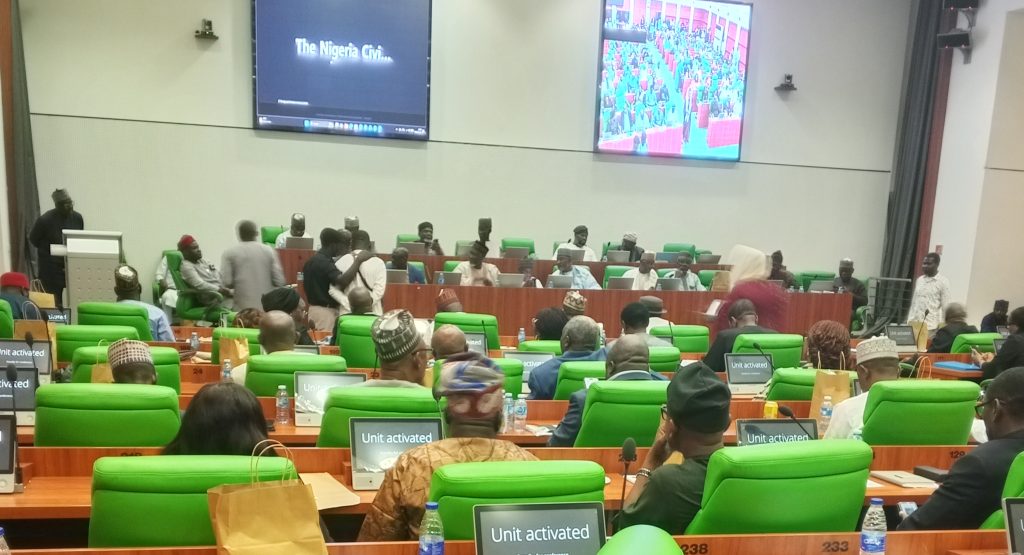
The public hearing was convened to consider a proposed revision to the statutory sharing formula for the five per cent Ticket, Charter and Cargo Sales Charge. It was also meant to address who should be paid for obstacle evaluation and WGS-84 survey work. What it became, however, was another round in a long-running tussle between NAMA and the Nigeria Civil Aviation Authority, NCAA, with both agencies quietly courting support from unions, operators and stakeholders.
It is a fight that, in the view of many industry watchers, should never have been politicized. Because in aviation, when politics walks in, safety limps.
NAMA’s Managing Director, Engr. Farouk Ahmed Umar, did not come with accusations. He came with numbers and with the reality of running air navigation services in a country the size of Nigeria.
On every ₦1,000 of ticket, charter or cargo sale, the law collects ₦50 as the five per cent charge. Of that ₦50, NAMA currently receives ₦11. That is 1.10 per cent of the actual sale. What NAMA is asking for is not a new tax. It is a re-allocation within the same ₦50 — raising its share to 56 per cent, or ₦28. The passenger pays nothing extra.
The reason, Umar explained, is that the cost of keeping the sky safe has outgrown a formula written for another era. In 2023 alone, NAMA spent over ₦21 billion on personnel, more than ₦12 billion on capital projects, and over ₦10 billion on overheads. That is a cost profile above ₦43 billion. Behind those figures are controllers, engineers, communication systems, navigation aids, surveillance platforms, power systems, software licenses and calibration teams spread across every corner of the country.
Unlike a printer that can wait till morning, a degraded communication link cannot. Unlike a meeting that can be postponed, radar support, navigation aid maintenance and controller training cannot be deferred without thinning the margin of safety.
Umar reminded lawmakers that some of NAMA’s charges have not changed since 2008. A navigation fee of ₦11,000 per flight has remained static while the cost of fuel, electricity, foreign exchange and imported spares has multiplied. Dedication has filled the gap, but dedication is not a funding policy.
The most urgent example is the Total Radar Coverage of Nigeria system. It has served the nation for years, but age is catching up. Spare parts are scarce. Manufacturer support is fading. Responsible management, NAMA argued, means planning replacement before failure, building redundancy, training people on new systems, and running old and new in parallel without a single day of compromise.
Then there is the issue of obstacle clearance. When a developer wants to erect a mast, tower, crane or high-rise, the NCAA issues the Aviation Height Clearance Certificate and collects the fee. But the technical question — will that structure interfere with a flight path, a navigation aid, or protected airspace — is answered by NAMA. It is NAMA that runs the surveys, validates the WGS-84 data, conducts the obstacle assessment and integrates it into procedure design. Yet it receives no direct payment for that safety-critical work. NAMA is asking that the technical component be paid directly to it under a 90-10 arrangement, with NCAA retaining the regulatory part. In line with ICAO’s cost-recovery principle, that money would go straight into maintaining the equipment and expertise that make the clearance meaningful.
What NAMA is really asking for is continuity. Air navigation is no longer just towers and radios. It is digital, satellite-driven, data-heavy and exposed to cyber risk. Performance-based navigation, digital aeronautical information, and integrated flight-data systems are the future. They promise shorter routes, fewer delays and better capacity. But they demand investment now.
A stronger NAMA, Umar told the committee, benefits everyone. Reliable surveillance allows tighter separation. Modern procedures cut fuel burn. Better system availability means fewer disruptions for airlines, airports, passengers, trade and national security. An aircraft moving efficiently through Nigerian airspace is an economic activity made possible by infrastructure most Nigerians never see.
To address fears of opacity, NAMA offered accountability upfront: automated collection and remittance, quarterly disclosure of receipts and projects, annual independent audit, transparent procurement, and measurable performance indicators. It also asked that the law be harmonized — the Civil Aviation Act currently lists 22 per cent for NAMA while the NAMA Act refers to 23 per cent. The statutes, it said, should speak with one voice.
The hearing laid bare a deeper problem. Two agencies that should be pulling in the same direction have found themselves mobilizing supporters, issuing statements and drawing battle lines. That is understandable in politics. It is dangerous in aviation. Because safety is not built on who shouts loudest. It is built on systems that work every second, whether anyone is watching or not.
As Engr. Umar put it, the amendment before the National Assembly is not just about dividing revenue. It is about deciding whether the institution that guides every aircraft in Nigerian airspace will have stable resources to maintain today and to build tomorrow. It is about choosing to fund safety proactively through planned maintenance, rather than reactively after systems break.
“Give us the means and hold us to the result,” he said. “Give Nigerian airspace the resilience it requires and require us to demonstrate that resilience.”
In the end, the question is not whether NCAA is important. It is. Regulation must be strong, training must be excellent, investigation must be independent. The question is whether we will also fund the invisible layer that translates regulation into movement — the controllers, the radar, the power, the people who make sure that when a pilot calls, someone answers.
That is NAMA’s work. It is unseen. It is unglamorous. But without it, nothing flies.
And on that, the country cannot afford to gamble.
