
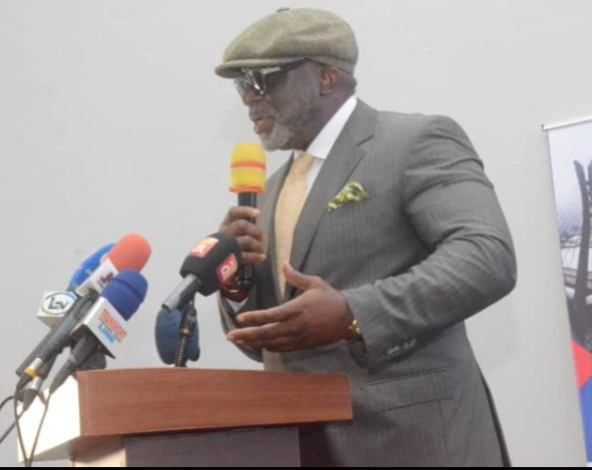
Prof Ralph Okonkwo
The ballroom at the 30th annual conference of the League of Airport and Aviation Correspondents in Lagos was packed on Thursday, but the mood was tense. The theme on the banner read “Towards a Sustainable Aviation Industry: Balancing government revenue demands with sector growth.” It could not have been more fitting.
Prof. Ralph Okonkwo, executive chairman of United Nigeria Airlines and spokesperson for the Airline Operators of Nigeria, took the podium to address a question that has dogged the sector for months: why is there money owed on the five percent Ticket Sales Charge (TSC), to the Nigeria Civil Aviation Authority.
His answer was blunt. The problem, he said, was not refusal to pay. The problem was interruption.
According to him, up until February this year, domestic airlines were up to date. “Before February this year, there were no payment problems. All airlines were paying,” he told the gathering. The trouble started, he explained, when aviation fuel climbed to N3,300 per litre, a spike he linked to the US-Iran crisis in the Gulf. Costs went up overnight. Margins that were already thin disappeared. It was AON that first raised the alarm.
Okonkwo said the operators wrote to the President, asking for either a complete suspension of charges or at least temporary relief while the crisis lasted. The request was granted. The President, he disclosed, approved a 30 percent waiver. That opened the door for talks.
What followed were several meetings with the NCAA and the Ministry of Aviation. In one decisive sitting, NCAA asked that airlines pay 10 percent of their legacy debts within a set period, and then spread the balance over instalments. Each airline was to sit with the Director of Finance to work out the details.
Okonkwo said the operators complied. Meetings were held in Lagos and Abuja. Payment plans were signed. Money began to move again.
To show good faith, United Nigeria went a step further. The airline opened joint accounts with NCAA in Nigerian banks, structured so that the regulator could make direct withdrawals without waiting for approvals.
“To ensure no issues, we opened joint accounts with NCAA,” Okonkwo said. “The account was structured so NCAA could withdraw funds directly without asking us.”
Then came the derailment. He did not name the union directly in the body of his remarks, but the reference was clear. “We were making regular payments according to the agreement we had with the NCAA until we heard about the labour union problem,” he said.
The picketing, the airport disruptions, the public confrontation. He described it as a “shameful display” that would have sunk the industry’s reputation but for the swift condemnation from stakeholders, including the Aviation Roundtable president and, he noted, many of the aviation journalists in the room.
Okonkwo pushed back hard against the narrative that operators are chronic defaulters. “When people discuss money not remitted or paid by operators, they fail to mention how much operators do pay,” he said.
He asked a pointed question in return: what has been done with all the money already collected? Beyond the five percent TSC, airlines already pay multiple taxes. And for the TSC specifically, he argued, there is little to show in return. When NCAA is invited to inspect an aircraft in London or America, airlines pay 100 percent in advance. So what, he asked, is the five percent for?
“To take five percent of any business, a business I borrowed money to run, a business that costs me sleepless nights, that is too much for anyone to extract from it,” he said.
His call was not for a pause but for an end. “The call for removal of this five percent must not stop. It must continue until we remove it. We would not be able to have smooth operations until this is resolved.”
He acknowledged that unions have a right to fight for worker welfare. Aviation, he said, is still among the best-paying sectors in Nigeria. But he maintained that shutting down airports is not the way to protect jobs. It endangers the very companies that employ the workers.
The picture he painted was of an industry that had found a way forward, only to have it cut short. A waiver was granted. A repayment structure was agreed. Joint accounts were opened. Payments were flowing. Then protests grounded movement and reset the conversation back to crisis.
As the conference ended, the question hanging in the air was not just about debt, but about trust and sustainability. Airlines say they are willing to pay if the burden is realistic and the value is visible. Regulators say they need the revenue to keep the system safe. Unions say workers cannot be left behind. And passengers, as always, are caught in the middle.
For now, the payment plan that Okonkwo described remains on paper. Whether it can be revived will depend on whether all parties can return to the table without another disruption. Because in an industry where fuel prices can jump in a week and a five percent charge can decide if a route survives, progress is fragile.
And as Lagos heard on Thursday, it only takes one derailment to stop a train that was finally moving.
