
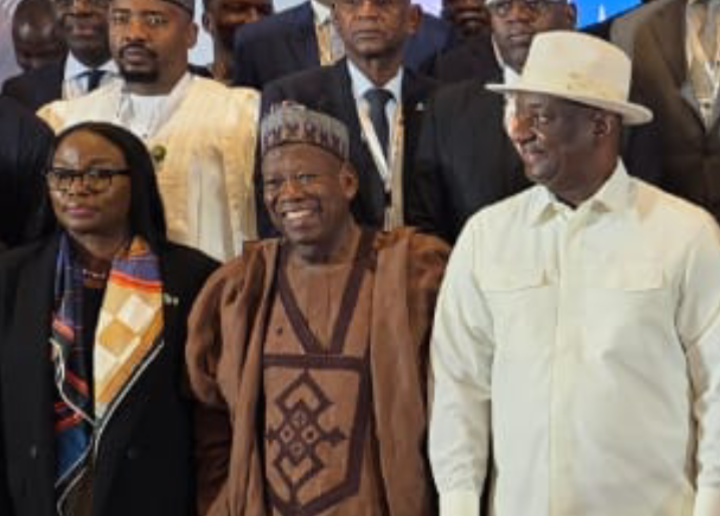
FAAN MD, Kuku, Chairman FAAN Board, Ganduje and Aviation and Aerospace Development Minister, Keyamo
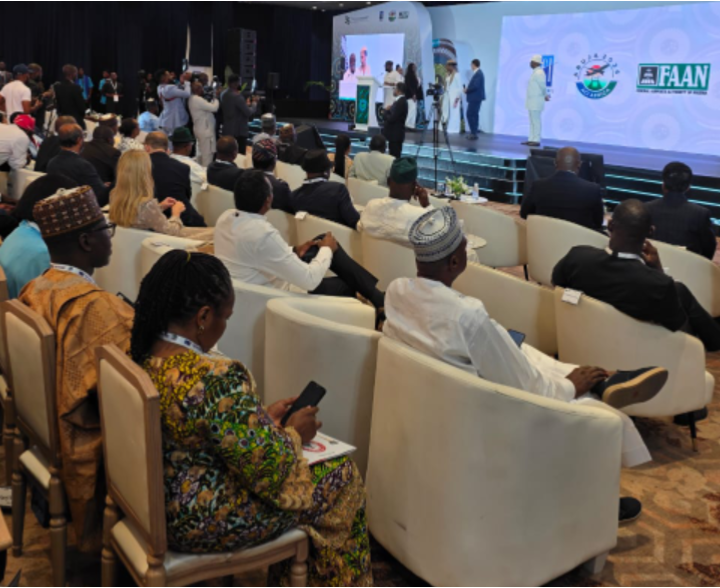
When Mrs Olubunmi Onabanjo-Kuku rose to welcome delegates to the ACI Africa Regional Conference & Exhibition 2026 at the Abuja Continental Hotel, she did so not just as the Managing Director and Chief Executive of the Federal Airports Authority of Nigeria, FAAN, but as Vice President of Airport Council International Africa, a leader speaking at the very centre of a continental shift.
Her welcome address was measured, data-rich, and unflinchingly candid. It was the portrait of a sector that is no longer waiting for permission to grow. It is already growing, and fast.
The conference theme, “Next-Gen Airports: Driving Performance and Resilience,” she said, “is not merely a conference title. It is a strategic mandate. It is a call to action.”
And the numbers prove her right.
In a month when global international passenger demand contracted by 0.1 per cent, African airlines, according to IATA figures quoted by Onabanjo-Kuku, posted a 6.4 per cent year-on-year increase in July 2026. While the world stalled, Africa accelerated. Overall passenger demand on the continent grew by 5.2 per cent, second only to Latin America and the Caribbean, and dwarfing the global average of 0.2 per cent.
“We are not just participating in global aviation recovery — we are leading it,” she told the hall of airport executives, regulators, financiers and airline leaders.
Nigeria, the host nation, is emblematic of that leadership. Africa’s most populous nation is now its fourth-largest aviation market, handling over 18.8 million domestic and international passengers in 2025, an 11.9 per cent growth.
Its flagship gateway, Murtala Muhammed International Airport in Lagos, whose oldest terminal is currently being rehabilitated, posted the fastest growth in scheduled seat capacity among Africa’s ten largest airports in September — a staggering 24.1 per cent.
The momentum has not slowed. Citing OAG data, Onabanjo-Kuku noted that Nigeria’s total scheduled airline capacity for September 2026 hit 1.19 million seats, up 37.4 per cent year-on-year, the fastest growth among the continent’s top ten markets.
She attributed this surge to bold currency reforms, new aircraft leasing agreements, and renewed confidence from international carriers. Since the current Minister of Aviation and Aerospace Development assumed office, several airlines have resumed Nigerian operations, with more expected.
“These figures are not abstract,” she reminded delegates. “They represent millions of Africans connecting with family, doing business, accessing healthcare, and exploring opportunities. They represent livelihoods.”
Yet, in what set her speech apart from mere celebration, the FAAN Chief Executive pivoted to a sober reality check. Growth alone, she warned, masks structural fragility.
Africa, with 18 per cent of the world’s population, accounts for just 1 per cent of global air traffic. Load factors lag global averages. Airline viability remains fragile. In Nigeria itself, a nation of over 220 million people, just 19.5 million passengers pass through 28 airports annually. The gap between potential and performance is enormous.
This, she argued, is not cause for despair but for deliberate, strategic action — confronting funding constraints, infrastructure gaps, high operating costs, fragmented connectivity, and the tension between keeping charges low and delivering world-class facilities.
It is precisely these headwinds that FAAN has been tackling since 2023 in what Onabanjo-Kuku described as a “deliberate transformation journey” that embodies resilience.
The results, detailed for the first time to an international audience, are instructive. On infrastructure, FAAN has prioritised safety and capacity over vanity projects — rehabilitating a major runway at MMIA Lagos, upgrading terminals and airfield lighting while keeping operations live.
On passenger experience, it has launched a dedicated Passenger Experience Hub, anchoring its operations on speed, predictability, comfort and human assistance. On digital transformation, it is deploying fast check-in, automated e-gates, enhanced security systems and passenger-data analytics where they deliver measurable value.
In January 2026, that discipline was validated when FAAN achieved dual ISO 9001:2015 and ISO 14001:2015 certifications — not, as Onabanjo-Kuku stressed, “merely a certificate on a wall,” but a systematic commitment to quality and environmental responsibility.
Behind it sits an investment in people: over 3,500 personnel trained and certified through ICAO and ACI programmes. And looking outward, FAAN has retooled its Directorate of Cargo Development Services to reposition Nigeria’s airports as logistics platforms for regional and international trade.
“These achievements are evidence that even in the most challenging environments, disciplined prioritisation, strong partnerships, and a commitment to our people can deliver results,” she said.
From this national experience, Onabanjo-Kuku scaled up to a continental vision for the next decade, outlining five imperatives that will define the African airport of 2036.
First is financial sustainability. African airports, she argued, must become commercial ecosystems, not just runways. They must diversify beyond aeronautical charges into logistics parks, hospitality, retail, data-driven services and airport-city developments. The land and connectivity around airports is untapped economic gold.
Second is intelligent infrastructure. The future is not just bigger terminals but smarter systems — predictive maintenance, reliable power, digital operations and data analytics. “The less visible investments often deliver the greatest returns,” she noted.
Third is operational resilience. Resilience, in her definition, is not an emergency manual but an organisational capability — redundancy, agility, intelligence and communication discipline built into daily operations to reduce the time between disruption and effective response.
Fourth is human capital. “Infrastructure depreciates; technology becomes obsolete; but a competent, accountable, and continuously learning workforce multiplies every investment,” she said, calling for a culture of continuous learning.
And fifth is partnerships. Government resources alone, she was blunt, cannot meet the scale required. Africa needs commercially viable partnerships with private investors, airlines, technology providers, logistics firms and development finance institutions.
Her closing was a call to collective action that resonated beyond the walls of the Abuja Continental.
To governments, she called for predictable, long-term, commercially disciplined frameworks that give airport leaders clear mandates, resources, commercial room and accountability. To development partners and financiers, she urged recognition of African airports as strategic economic infrastructure with immense developmental returns.
To fellow airport CEOs, she called for bold, strategic prioritisation — funding the essential projects that protect safety, build capacity, generate revenue and strengthen resilience.
And to everyone, she issued a reminder of purpose: “Aviation is ultimately about connecting people. Every passenger who passes through our airports carries dreams, responsibilities, and aspirations. We must build airports worthy of that trust.”
As delegates applauded, the context was clear. The African Continental Free Trade Area provides the framework for integrated connectivity. The Single African Air Transport Market offers the policy architecture for liberalised skies. A young, digitally native workforce offers the talent to leapfrog legacy systems.
“The decade ahead belongs to Africa,” Onabanjo-Kuku declared. “Our passenger growth is outpacing the rest of the world. Our infrastructure is being renewed. Our institutions are strengthening. Our connectivity is expanding. We have shown that African aviation does not merely survive — it adapts, innovates, and grows.”
Abuja, for three days, is not just hosting a conference. It is hosting a blueprint for how a continent that moves only 1 per cent of the world’s air traffic today will carry a far greater share of the world’s aspirations tomorrow.
