

NAMA MD, Engr Farouk Ahmed Umar
Amid ongoing discussions within Nigeria’s aviation sector, particularly around the distinct roles of agencies, one truth stands out with clarity: while regulation sets the standard, it is operations that keep aircraft in the air.
The Nigerian Civil Aviation Authority, NCAA, rightly serves as the regulatory authority, responsible for oversight, compliance, and enforcement of aviation standards. But the Nigerian Airspace Management Agency, NAMA, remains the operational backbone of Nigeria’s airspace, the agency that provides the critical, real-time infrastructure and technical services that make flight possible from the moment a pilot pushes the throttle to the final touchdown.
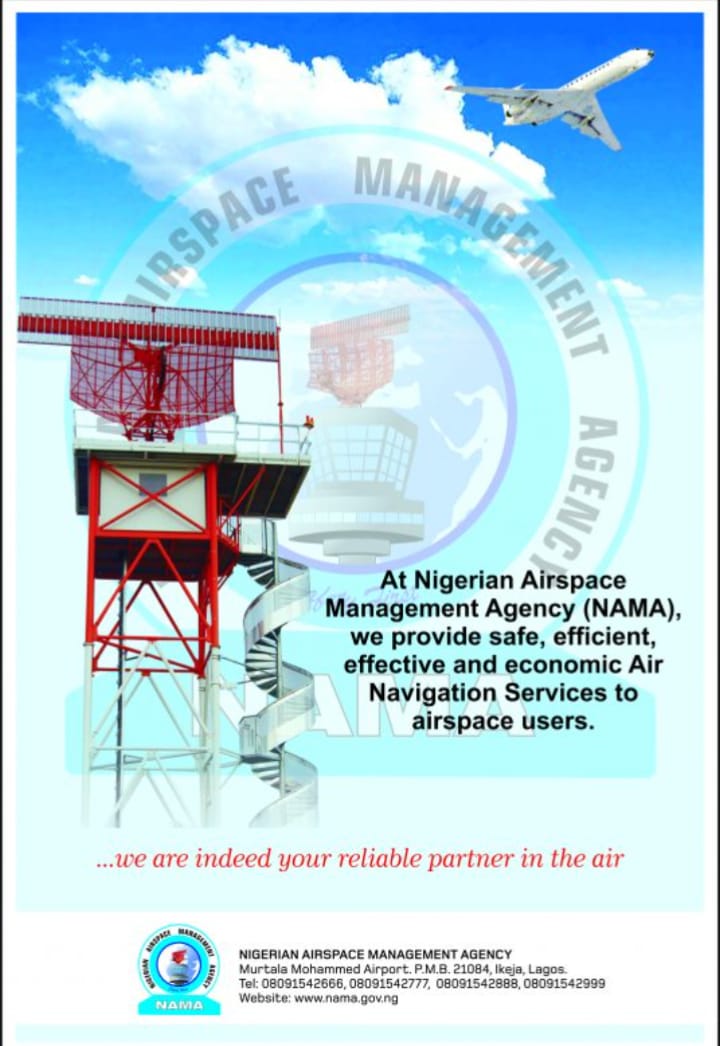
NAMA is Nigeria’s sole Air Navigation Services Provider, the government agency charged with managing the country’s airspace and delivering air navigation services to ensure safe and efficient air travel. Its mandate revolves around three safety-critical pillars that pilots and controllers depend on every minute: Communication, Navigation, and Surveillance, otherwise known as CNS.
These are not abstract functions. They are the voice in the cockpit, the signal on the instrument panel, and the blip on the radar screen that tells a controller where every aircraft is.
NAMA provides air traffic control, communication, navigation and surveillance services, aeronautical information services, and search-and-rescue coordination support. It coordinates aircraft spacing, reroutes flights when necessary, and ensures safe separation between aircraft. Without that, there is no orderly flow, no safety, and no air transport system.
Every aircraft that departs or arrives within Nigerian airspace depends fundamentally on NAMA’s network. Across the country, far beyond the four major international airports, NAMA maintains an extensive architecture of Instrument Landing Systems, Doppler VOR facilities, Distance Measuring Equipment, radar installations, VHF communication stations, satellite-enabled surveillance platforms and numerous remote navigational facilities.
These systems operate as a single integrated network supporting the safe movement of aircraft throughout Nigerian airspace. From Lagos to Maiduguri, from Port Harcourt to remote airstrips, the same standard applies because the same agency is watching.
The work is technology-intensive and unrelenting. The rapid evolution of satellite navigation, digital communications, surveillance technology and automation has fundamentally changed how airspace is managed worldwide, and NAMA is under constant pressure to modernise in line with ICAO Standards and Recommended Practices.
To meet that demand, the agency uses radar systems, satellite navigation, VHF communication, and modern surveillance systems, and has commenced deployment of Automatic Dependent Surveillance-Broadcast, ADS-B, as a reliable backup to existing radar to ensure continuous, real-time surveillance. It also runs a dedicated flight inspection and calibration aircraft to periodically verify ILS, VOR, DME and other CNS/ATM infrastructure for accuracy and integrity.
Those calibration exercises cannot be postponed without compromising the integrity of the air navigation system itself.
What makes NAMA’s burden unique is that these facilities must run 24 hours a day, in remote locations, often on diesel generators because aircraft fly irrespective of power outages. The agency expends enormous resources on maintenance, generator fuel and uninterrupted power supply just to keep the lights on the navigational aids. It is also expanding coverage through Multilateration technology in the Gulf of Guinea to monitor low-flying aircraft supporting oil and gas operations, and through Performance-Based Navigation to enable efficient flight paths that reduce fuel burn and environmental impact.
Importantly, NAMA does not operate in a vacuum. It works under the supervision of the NCAA, which audits compliance levels, validates inspection cycles and mandates corrective actions whenever deficiencies are identified. The relationship is complementary, not competitive. NCAA sets and enforces the rules. NAMA builds and runs the systems that make those rules real in the sky.
NAMA is also preparing for ANSP Certification by NCAA and the ICAO Universal Safety Oversight Audit Programme, with a comprehensive FIR audit covering ATS, CNS, AIM and SAR operations across Lagos, Abuja, Kano, Port Harcourt and other aerodromes.
Passengers may never see the VOR stations in the bush, the radar towers on hilltops, or the engineers climbing masts at 2am. But every safe flight is a testament to their reliability. When a controller in Lagos guides an aircraft through bad weather, when a pilot in Kano captures the ILS for landing, when a helicopter in the Niger Delta is tracked beyond radar coverage, that is NAMA.
In an industry where safety is non-negotiable, Nigeria cannot afford to confuse roles. Regulation is vital. But the day-to-day guardian of the skies, the agency that turns policy into pulses, signals and separations, is NAMA. It is the true guardian of Nigeria’s airspace and the backbone on which flight safety rests, ensuring that from takeoff to landing, every Nigerian flight has a clear path, a clear voice, and a clear chance to arrive safely.
